


This sports betting SEO case study shows how a global sportsbook project moved from paid-traffic dependency to a stronger organic acquisition model. Before the campaign, SEO generated less than 5% of total registrations. Most new users came from paid channels, which created a clear risk: as soon as media spend slowed down, acquisition slowed down with it.
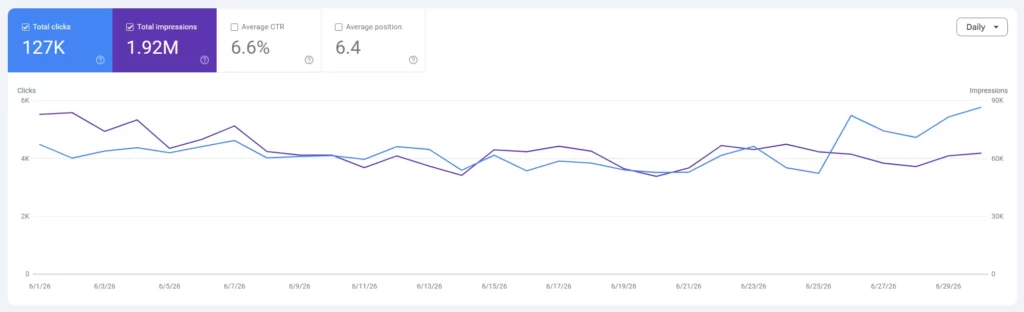
Over 10 months, the website grew from 22,000 to 127,000 organic clicks per month. That is an increase of 105,000 monthly clicks, or roughly 477% growth compared with the starting point. The project also reached 1.92 million Google impressions, a 6.6% CTR, and an average position of 6.4 in Google Search Console. Google defines clicks, impressions, CTR, and average position as the core metrics in the Search Console Performance report, so these numbers gave a clean view of how visibility and traffic changed during the campaign.
Key Results
| Metric | Starting Point | Result After 10 Months | Growth |
|---|---|---|---|
| Organic traffic | 22K/month | 127K/month | +477% |
| Monthly traffic increase | — | +105K clicks | 5.7x growth |
| Registrations from SEO | Less than 5% of total registrations | Strong organic registration channel | +410% |
| FTD growth | Low SEO-driven deposit volume | SEO became a stronger FTD source | +295% |
| Google impressions | — | 1.92M | Strong visibility growth |
| Average CTR | — | 6.6% | Improved click performance |
| Average position | — | 6.4 | Stronger ranking footprint |
| Keywords in Top 3 | — | 610 | High-value ranking gains |
| Keywords in Top 10 | — | 4,800 | Broad SERP coverage |
The most important result was not only the increase in clicks. The real business value came from the shift in acquisition quality. SEO stopped being a minor support channel and became a measurable source of registrations and first-time deposits. A +410% increase in registrations from SEO means organic traffic was not just informational traffic. It was reaching users with betting intent.
Project Background
The website operated in the sportsbook industry and targeted a global audience. That made the project competitive from the start. Sports betting SEO is difficult because the search landscape changes every week. New events appear, odds move, leagues restart, tournaments end, and user demand often peaks for a short time before disappearing.
At the beginning of the campaign, the website relied heavily on paid traffic. Paid campaigns brought registrations, but they also kept acquisition costs high. Organic search had a much smaller role, generating less than 5% of registrations. For a sportsbook brand, that is a weak position because many high-intent users search directly for match previews, betting guides, live event pages, odds explanations, and event-specific betting opportunities.
The challenge was to build an SEO system that could support both evergreen traffic and event-driven traffic. The website needed betting guides for stable search demand, live event landing pages for time-sensitive queries, and stronger internal linking to move users from informational content toward sportsbook pages.
The Main Challenge
The project did not start from zero. It already had a base of 22,000 organic clicks per month, which proved that Google could see the site and that some pages already had search demand. The real problem was different: this traffic was not strong enough to influence acquisition in a serious way. SEO existed as a visibility channel, but it was not yet connected to registrations, deposits, or measurable business growth.
The site already had organic search activity, but this traffic was not strong enough to move acquisition. SEO needed to become more than a visibility channel. It had to support registrations, deposits, and commercial sportsbook pages.
Not Enough Event Landing Pages
The site had too few pages built around active sports demand, which limited visibility for matches, tournaments, and live-event searches.
Betting Guides Were Weak
Several guide topics were missing, too thin, or not structured around user intent, leaving evergreen sportsbook demand underused.
Internal Links Lacked Commercial Flow
Content pages did not pass enough relevance to commercial sportsbook pages, so priority URLs were not getting enough internal support.
There was also a technical layer to fix. Core Web Vitals became part of the strategy because sportsbook users move quickly between event pages, odds, markets, and live content. The site had to feel fast, responsive, and stable, especially on mobile. That is why performance work focused on LCP, INP, and CLS, improving loading speed, interaction response, and layout stability for both SEO and user experience.
SEO Strategy
The strategy was built around five areas: sports event content, betting guides, live event landing pages, internal linking, and digital PR. The reference case used as a structural example also focuses on technical optimization, content localization, and backlink work for betting projects, but this case was rebuilt around a different traffic profile and a 10-month growth period.
| SEO Area | What Was Done | Why It Mattered |
|---|---|---|
| Sports event content | Created and optimized pages around major matches, leagues, and tournaments | Captured short-term demand from users searching before and during events |
| Betting guides | Built educational content for markets, bet types, strategy, and sportsbook features | Added stable evergreen traffic and supported users earlier in the funnel |
| Live event landing pages | Developed pages for active events and high-demand fixtures | Matched urgent search intent and improved commercial relevance |
| Internal linking | Connected guides, previews, and event pages to priority sportsbook sections | Passed relevance to key pages and improved user flow |
| Digital PR | Earned links and mentions from relevant sports and betting-related websites | Strengthened authority and helped competitive pages rank higher |
| Core Web Vitals | Improved loading speed, responsiveness, and layout stability | Reduced technical friction and improved page experience |
The strategy worked because it did not treat sportsbook SEO as a normal blog project. A sports betting website needs more than generic articles. It needs a structure that reacts to the sports calendar, supports evergreen search demand, and guides users toward registration and deposit actions without forcing the journey.
Sports Event Content Strategy
The first major change was the event content model. Instead of publishing random previews, the content plan was connected to the sports calendar. Priority was given to events with clear search demand: major football matches, international tournaments, derby games, title races, cup finals, and fixtures involving teams with strong global search interest.

Each event page had a clear purpose. Some pages targeted users looking for betting previews. Others focused on market explanations, odds movement, or live betting angles. This helped the website capture traffic from different stages of the betting journey. A user searching for a general match preview is not always ready to register. A user searching for live betting markets or event odds is usually much closer to action.
The strongest event pages were updated before matchday, monitored during the traffic window, and then connected to future relevant pages. This prevented the site from creating isolated event URLs that lost value after the match ended.
Betting Guides and Evergreen Growth
Betting guides were used to build a more stable SEO base. Event pages can bring sharp traffic spikes, but guides help keep traffic moving when there are fewer major fixtures. The campaign focused on topics that users repeatedly search for: bet types, odds formats, accumulator betting, handicap markets, over/under betting, live betting, cash out, bankroll management, and sport-specific betting rules.
These guides were written to answer real user questions, not just to target keywords. Google’s own documentation says its ranking systems are designed to prioritize helpful, reliable, people-first content, which is why the guide strategy focused on clarity, practical examples, and direct explanations rather than thin SEO copy. The guides also played an internal linking role. They helped move users from informational searches to event pages, sportsbook sections, and registration-focused URLs. This gave the site more than traffic. It created a better path from search query to business action.
Live Event Landing Pages
Live event landing pages became one of the most important commercial parts of the campaign. These pages were designed for users searching close to match time, when intent is usually stronger. A page targeting a live fixture or active tournament can attract users who already know what they want to bet on and are comparing options quickly.
The landing pages were built with short paths to relevant sportsbook areas, better internal links, and updated content blocks. The goal was not to overload the page with text. The goal was to match the moment. Users searching around live sports events usually need fast information, clear navigation, and direct access to the relevant market.
This helped the campaign connect SEO traffic with registrations and FTD growth. The project did not simply increase monthly clicks from 22K to 127K. It also improved the quality of that traffic, which is why registrations from SEO grew by 410% and FTDs increased by 295%.
Internal Linking and Digital PR
Internal linking was used to connect the whole structure. Betting guides supported event landing pages. Event pages linked to related competitions and sportsbook sections. High-performing pages were used to pass more relevance toward URLs with conversion potential.
The digital PR layer supported the same logic. Links were not sent randomly to any page that needed a boost. Priority went to pages with ranking potential, strong content, and commercial value. This helped strengthen the pages that were already moving and made the link building budget more efficient.
Betting Guides
Evergreen guides supported event pages and helped move users from education to sportsbook intent.
Event Pages
Event pages linked to related competitions, live pages, and commercial sportsbook sections.
Relevance moved toward conversion pages
High-performing content passed stronger signals to URLs with ranking and acquisition potential.
Relevant Authority
External links supported pages with strong content, visible ranking potential, and commercial value.
Smarter Link Allocation
Links were not sent randomly. Priority went to pages that were already moving in search results.
Results After 10 Months
After 10 months, the website grew from 22K to 127K organic clicks per month. That means the project added around 105K monthly organic visits. On a daily level, the site moved from roughly 730 organic clicks per day to more than 4,200 clicks per day on average. The ranking growth was also strong. The site reached 610 keywords in the Top 3 and 4,800 keywords in the Top 10. This shows that growth was not based on one or two lucky pages. The website expanded across a broader keyword set and started competing in both high-volume and long-tail search results. The Search Console data also showed 1.92M impressions, 127K clicks, 6.6% CTR, and an average position of 6.4. A 6.6% CTR is especially useful in this context because sportsbook SERPs can be crowded. Better titles, sharper page intent, and stronger rankings helped turn visibility into real visits.
Conclusion
This sports betting SEO case shows how a sportsbook project can reduce paid-traffic dependency by building a stronger organic acquisition system. The website started with 22K monthly organic clicks and SEO generating less than 5% of registrations. After 10 months, organic traffic reached 127K clicks per month, registrations from SEO increased by 410%, and FTD growth reached 295%. The result came from a practical SEO mix: event-led content, evergreen betting guides, live landing pages, internal linking, digital PR, and Core Web Vitals improvements.
The campaign worked because it followed how sportsbook users actually search. Some users need education. Some compare events. Some arrive close to match time ready to act. The SEO structure had to serve all three groups. By the end of the campaign, SEO was no longer a small support channel. It became a serious acquisition source with measurable traffic, rankings, registrations, and deposit growth.