

Online bingo sites compete across game pages, bonuses, payment queries, and practical player questions. Bingo SEO services connect that demand with technically sound pages, precise keyword targets, and compliant information. SEO Rockets builds organic search programmes for operators and affiliates seeking qualified visitors, stable rankings, and measurable registrations across licensed markets.
Each campaign begins with crawl data, search demand, competitor evidence, and conversion paths. Work covers content, internal links, mobile performance, indexation, and authority. Every task has an owner and metric. Reporting connects releases with impressions, clicks, technical health, assisted registrations, and revenue signals, creating an accountable route from diagnosis to organic growth.
Why Choose SEO Rockets for Your Bingo Website?
SEO Rockets understands bingo search pressures. Operators need commercial visibility without thin bonus pages or regional compliance breaches. Affiliates require useful comparisons, accurate disclosures, and clear routes toward licensed partners.
Technical work uses crawl logs, Search Console, and field data. Mobile-first indexing requires equivalent mobile content, metadata, and crawl access.
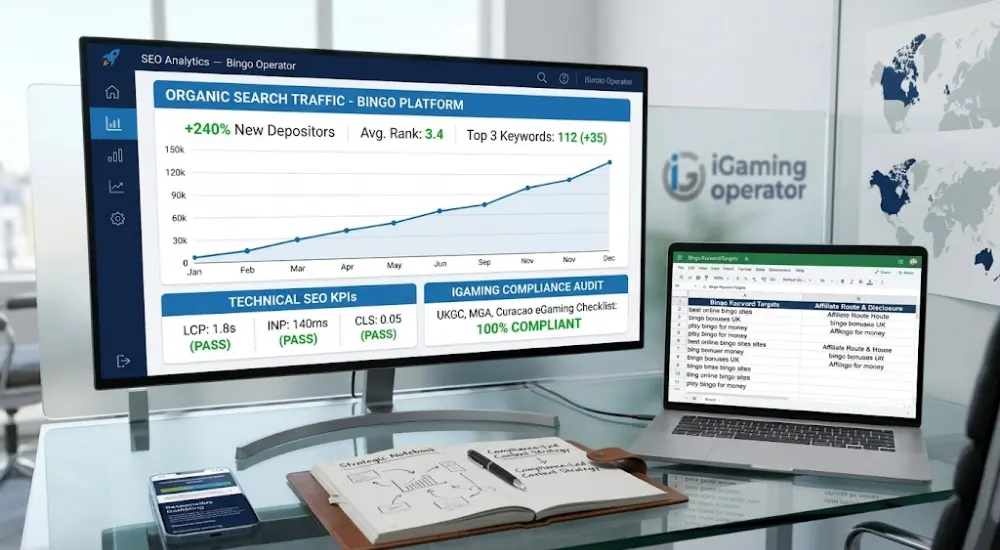
Targets include LCP within 2.5 seconds, INP below 200 milliseconds, and CLS below 0.1. FID appears only in legacy reports. Crawl reviews target filters, parameters, and expired promotions.
Campaigns reflect local advertising codes, licences, age controls, disclosures, and bonus rules.
- Direct iGaming experience across operator and affiliate websites
- Compliance-aware SEO for regulated and restricted markets
- Data-led technical audits tied to indexation and performance
- Conversion-focused content built around player intent
| Core offer | Client benefit |
|---|---|
| Technical, content, authority, and compliance work under one plan | Fewer ranking blockers and clearer paths from search to registration |
Our Approach to Bingo SEO
Each phase produces a deliverable, deadline, and KPI. Baselines separate campaign gains from seasonality.
Audits establish technical and competitive conditions. Keyword planning assigns demand to existing or new pages.
On-page and technical changes correct relevance, crawlability, speed, and conversion barriers.
Reporting tracks clicks, rankings, indexation, Core Web Vitals, registrations, and referring-domain quality.
- Audit
- Keyword research and strategy
- On-page optimisation
- Technical remediation
- Mobile testing
- Link building
- Reporting and refinement
| Phase | Key deliverable |
|---|---|
| Audit | Prioritised technical and content backlog |
| Keyword and strategy | Search-intent map and page plan |
| On-page | Updated templates, copy, metadata, and links |
| Technical | Validated fixes and crawl controls |
| Mobile | Device-level usability and speed report |
| Link building | Relevant placements and risk log |
| Reporting | KPI dashboard with completed actions |
Website Audit & Competitor Analysis
Comprehensive technical evaluation across crawling, indexation, speed, and backlinks to deliver a prioritized optimization backlog.
Audit Vectors & Tooling Integration
-
Server Logs
Expose bot activity and crawling patterns across technical assets.
-
Search Console
Identifies indexation exclusions and canonicalization conflicts.
-
Lighthouse & CrUX
Compares laboratory performance findings directly with field data.
-
Ahrefs, Majestic, Semrush
Assesses backlink profile quality and anchor distribution.
Audit Scope
- Crawl errors and orphan pages
- Indexation, canonicals, sitemaps, and robots directives
- Page speed and Core Web Vitals
- Structured data validity
- Backlink quality and anchor distribution
- Content gaps and cannibalisation
- Competitor SERP features
| Metric | Client site | Strong competitor | Gap |
|---|---|---|---|
| Indexed priority pages | Audit value | Benchmark value | Calculated difference |
| Valid CWV URLs | Audit value | Benchmark value | Calculated difference |
| Relevant referring domains | Audit value | Benchmark value | Calculated difference |
Keyword Research and SEO Strategy
Bingo keyword research separates registration intent from rules, rooms, bonuses, payments, and reviews. Geo modifiers are checked against licensing. Affiliate queries need comparison evidence; operator queries require direct access. SERP analysis identifies page types, features, freshness, and difficulty.
| Keyword | Intent | Monthly volume | Difficulty | Priority |
|---|---|---|---|---|
| online bingo games | Commercial | Tool data | Tool data | High |
| how to play 90-ball bingo | Informational | Tool data | Tool data | Medium |
| licensed bingo sites in [market] | Commercial and local | Tool data | Tool data | High |
- Classify intent and target market.
- Group close variants into semantic clusters.
- Match each cluster to one primary URL.
- Place pages within discovery, comparison, and registration funnels.
- Set 3-, 6-, and 12-month KPI checkpoints.
On-Page SEO and Content Optimisation
Titles state page purpose. Meta descriptions support qualified clicks without unsupported claims. Headings separate rules, schedules, payments, and eligibility. Links connect guides, hubs, and commercial pages. CTAs match visitor intent.
- Game guides and rules
- Bonus and promotion explainers
- Operator or room reviews
- Payment tutorials
- Responsible-play resources
- FAQs with valid structured data
| Template field | Writer requirement |
|---|---|
| Title | Intent-led search title |
| H1 | Clear page subject |
| Intro | Direct answer and value |
| 3 subheads | Rules, evidence, and next action |
| CTA | Stage-appropriate instruction |
| Schema | Supported type matching visible content |
Semantic HTML, canonicals, responsive images, and lazy loading support crawling and speed. Schema must match visible content. FAQ markup cannot guarantee rich results.
Technical SEO and Mobile Usability
Protecting discovery, rendering, indexation, and play across desktop and mobile environments.
Protects discovery, rendering, indexation, and play.
Mobile and desktop need equivalent primary content and metadata.
HTTP/2 or HTTP/3, CDN delivery, compression, caching, and lean JavaScript reduce delays.
Requires a measurable publishing need.
Optimization Directives
- Enforce HTTPS and one canonical host
- Validate canonicals and regional hreflang pairs
- Review robots.txt and XML sitemaps
- Test structured data and response codes
- Remove redirect chains and soft 404s
- Control parameters, filters, and expired promotions
| Issue | Impact | Priority |
|---|---|---|
| Blocked game resources | Incomplete rendering | Critical |
| Slow LCP | Delayed primary content | High |
| Duplicate regional URLs | Split signals | High |
| Oversized scripts | Weak INP | Medium to high |
Link Building and Website Authority
Authority work targets relevant editorial placements. Prospects are checked for topical fit, traffic, indexation, ownership, and gambling policies. Anchors remain varied and mostly branded. Disavowal decisions require evidence.
- Content partnerships with gaming publishers
- Outreach to bingo and entertainment sites
- Transparent affiliate relationships
- Data-led digital PR
- Useful resource-page inclusion
- Broken-link reclamation
| Tactic | Expected outcome | Timeframe |
|---|---|---|
| Data-led PR | Editorial citations and branded demand | 2–6 months |
| Niche outreach | Relevant referring domains | 1–4 months |
| Link reclamation | Recovered equity and referral traffic | 2–8 weeks |
How SEO Can Benefit Your Bingo Business
SEO builds discovery across commercial and informational searches. Value depends on qualified actions, not raw sessions.
Visibility grows when each intent reaches a suitable page.
Traffic quality improves when content answers a need before offering the next step.
Repeated accurate appearances strengthen brand recognition.
- Organic revenue and assisted registrations
- Conversion rate by landing page
- Average engaged session duration
- Pages viewed within conversion journeys
- Organic cost per aфcquisition reduction

| Investment | Expected 6–12 month outcomes |
|---|---|
| Technical fixes, content clusters, internal links, and relevant authority | More qualified visibility, stronger mobile conversion paths, and lower organic acquisition cost |
Greater Visibility for Relevant Searches
Commercial pages target licensed sites, rooms, bonuses, or payments. Editorial pages answer rules, odds, pricing, and terminology. Intent determines the correct format. Accurate structured data can aid machine understanding.
- Featured snippets
- Review or product presentations where eligible
- Video and image results
- Local results for legitimate physical venues
| Query type | Recommended page type | KPI |
|---|---|---|
| “bingo sites in [market]” | Regulated comparison or operator page | Qualified registrations |
| “how does 75-ball bingo work” | Rules guide | Engaged organic sessions |
More Qualified Organic Traffic
Semantic mapping links questions to suitable actions. Readers move from guides or reviews toward comparisons and licensed sites. GA4 events record CTA clicks, form starts, registrations, and deposit milestones. UTM tags and consent-aware server-side tracking support attribution.
- Informational guide → useful resource → registration page
- Review → comparison → compliant sign-up link
| Funnel stage | Content example | CTA |
|---|---|---|
| Awareness | 90-ball bingo rules | View playable rooms |
| Evaluation | Bingo room comparison | Compare verified terms |
| Action | Operator landing page | Create an eligible account |
Stronger Brand Recognition
Recognition grows when brand facts remain consistent across touchpoints. Author credentials, editorial checks, ownership details, and correction policies provide trust evidence. Organization markup cannot replace reputation.
Trust & Authority Signals
Building brand authority relies on verifiable signals and consistent organizational details across all digital publishing channels.
Key Brand Components
- Branded research and editorial content
- Expert authors with review dates
- Relevant PR and industry partnerships
- Consistent business details where applicable
- Organization structured data
| Tactic | Brand metric improved |
|---|---|
| Credible citations and branded research | Branded searches and assisted conversions |
Common SEO Mistakes on Bingo Websites
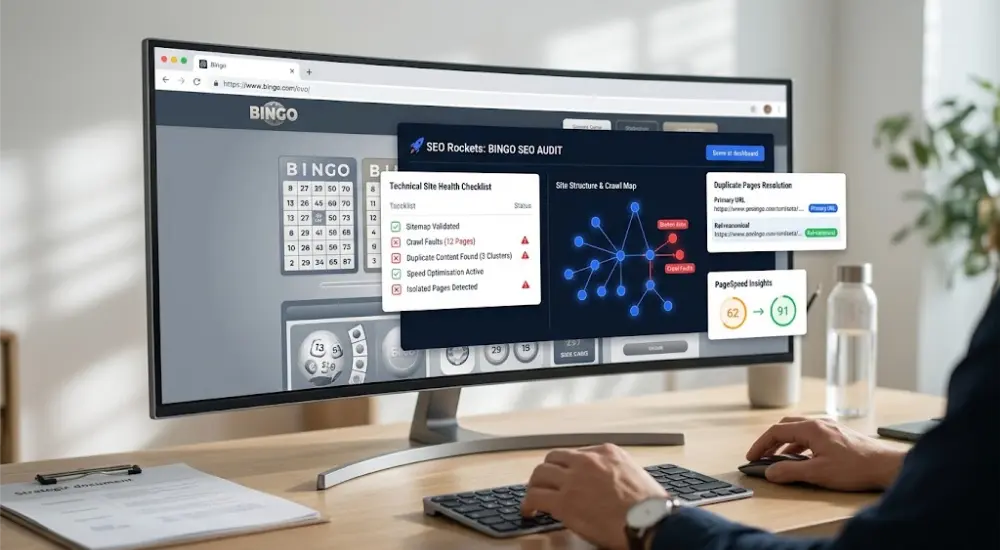
Bingo sites lose visibility through mismatched intent, repetition, stale offers, and crawl faults. Poor links may prioritise filters.
Keyword mismatch sends readers elsewhere. Duplication divides relevance. Technical neglect leaves pages isolated or excluded.
- Reassign each keyword cluster to one suitable URL
- Merge or canonicalise repeated pages
- Refresh regulated claims, dates, and terms
- Link hubs to priority child pages
- Repair status, rendering, and speed faults
| Mistake | Symptom | Fix |
|---|---|---|
| Intent mismatch | Rankings without useful actions | Replace or remap the page |
| Duplicate content | Several URLs alternate in results | Consolidate and redirect |
| Weak internal linking | Orphan pages receive few crawls | Add contextual hub links |
Targeting Keywords Without Understanding Search Intent
A query such as “how to play bingo” needs instructions, not registration. Validate intent through recurring result types, formats, SERP features, and query refinements.
| Keyword | Correct page type |
|---|---|
| how to play 90-ball bingo | Step-based rules guide |
| bingo welcome offer terms | Current promotion terms page |
Publishing Duplicate or Outdated Content
Repeated game descriptions, provider text, and expired bonuses weaken distinction. Site searches, crawl exports, canonical checks, and similarity tools expose competing URLs. Retained pages need a defined purpose and review date.
- Consolidate overlapping pages and redirect retired URLs
- Use canonicals only for true preferred duplicates
- Refresh offers, laws, payment details, and screenshots
| Content type | Recommended action | Frequency |
|---|---|---|
| Bonus page | Verify terms and expiry | Weekly or per campaign |
| Game guide | Check rules and links | Every 6 months |
| Regulatory page | Review jurisdiction details | Quarterly or after changes |
Technical Issues & Internal Links
Resolving technical bottlenecks and optimizing internal site architecture to safeguard search discovery and crawl efficiency.
Overlooking Technical Issues
Slow templates, broken canonicals, redirect loops, and orphan pages obstruct discovery. Links should express hierarchy without repetitive anchors.
Internal Linking Best Practices
- Build game, guide, and market hub pages.
- Keep related content within coherent topic groups.
- Use descriptive, varied anchors in relevant sentences.
| Technical issue | Diagnostic metric | Fix |
|---|---|---|
| Slow LCP | CrUX and Lighthouse | Compress the hero asset and improve delivery |
| Weak INP | Field INP and long tasks | Reduce main-thread JavaScript |
| Orphan page | Inlinks and crawl depth | Add links from the correct hub |
Our iGaming SEO Case Studies
SEO Rockets uses verifiable baselines and comparable post-change periods. NDAs protect client data.
Problem: A multi-region site had duplicate location pages. Approach: The campaign mapped canonicals, hreflang, links, and sitemaps. Results: Priority-page indexation stabilised; figures remain under NDA.
| KPI | Before | After | % change |
|---|---|---|---|
| Valid priority URLs | Confidential | Confidential | Withheld under NDA |
| Non-canonical crawls | Confidential | Confidential | Withheld under NDA |

Problem: An affiliate had isolated reviews. Approach: SEO Rockets created hubs, refreshed evidence, and added tracked links. Results: Visibility and assisted sign-ups improved; figures remain private.
| KPI | Before | After | % change |
|---|---|---|---|
| Organic clicks | Confidential | Confidential | Withheld under NDA |
| Assisted sign-ups | Confidential | Confidential | Withheld under NDA |
Published cases require Search Console comparisons, rank snapshots, traffic graphs, CrUX changes, and client permission.
Get Started with SEO for Your Bingo Website
Onboarding defines commercial targets, market access, technical condition, measurement, and responsibilities.
- Request a free site audit.
- Join a discovery call with relevant stakeholders.
- Review the scope, priorities, pricing model, and proposal.
- Approve access and begin the kickoff sprint.
Place the contact form below this section, followed by the audit checklist. Keep fields mobile-friendly. Pricing may use an audit, retainer, or project.
| Onboarding step | Client input required | Timeline |
|---|---|---|
| Audit request | Domain, market, and contact details | 1 business day |
| Discovery call | Goals, blockers, and internal resources | 30–45 minutes |
| Proposal | Budget range and approval route | 2–5 business days |
| Kickoff | Access, stakeholders, and tracking status | 3–7 business days |