


This Parasite SEO campaign was built around one clear goal: generate fast affiliate revenue in Malaysia without spending months growing a new domain from zero. The project had a limited budget, a short 30-day window, and a market where timing mattered. Waiting for a fresh website to build authority was not realistic, so the campaign used high-authority third-party placements, sharp keyword targeting, and fast performance tracking.
The result was strong for such a small test. With only $120 invested, the campaign generated $4,800 in affiliate revenue, reached 13,200+ organic clicks, and secured Top 3 rankings for 18 keywords. Search Console data also showed 13.7K clicks, 30.3K impressions, a 45.3% CTR, and an average position of 2.5 during the tracked period.
Key Results
The numbers show why this campaign worked as a fast affiliate test. The gross return was 40x the initial investment, while net profit reached $4,680. On a daily level, the campaign generated around $160 in revenue per day and roughly 440 organic clicks per day. For a 30-day affiliate campaign with a small budget, the main value was not only traffic. It was traffic that ranked quickly, clicked strongly, and converted into revenue.
Project Background
The campaign targeted the Malaysian affiliate market, where search demand can be narrow, competitive, and highly commercial. A normal SEO approach would have taken longer: build a domain, publish content, earn authority, wait for rankings, then optimize conversions. That was not the right model for this test. The project needed to validate revenue potential fast.
Parasite SEO was used because high-authority websites already had stronger ranking signals than a fresh affiliate domain. The campaign placed optimized content on selected third-party properties, then supported those pages with on-page improvements, authority links, and CTR-focused updates. The goal was to use existing authority, but still keep the campaign controlled and performance-based.
This was not a broad content campaign. It did not try to cover the whole Malaysian affiliate market. The focus stayed tight: selected keywords, selected placements, selected pages, and daily tracking. That helped keep the $120 budget from being wasted on low-intent traffic.

The Main Challenge
The main challenge was speed. The project had to generate affiliate revenue within 30 days, which meant every part of the strategy had to be practical. There was no room for slow domain growth, unnecessary content volume, or expensive link testing. The pages had to rank fast and attract users who were already close to taking action. The campaign also had to work inside a small budget. That made keyword selection even more important. Chasing broad, highly competitive keywords would have burned the budget quickly. The better route was to find Malaysian search terms with commercial value, realistic ranking difficulty, and clear affiliate intent.
Malaysia-focused keywords
The campaign needed localized search terms that could rank within a short window and still carry strong affiliate revenue potential.
High-authority placements
Instead of waiting for a new domain to build trust, the strategy used authority websites that could enter Google results faster.
Support only proven pages
Budget was focused on pages that showed early ranking movement or clear conversion potential, instead of spreading links too widely.
This made the campaign lean. Instead of spreading effort across too many pages, the strategy focused on opportunities that could bring clicks and revenue quickly.
Strategy Overview
| Strategy Area | What Was Done | Why It Mattered |
|---|---|---|
| Malaysia keyword research | Selected localized affiliate keywords with clear commercial intent | Reduced wasted traffic and improved conversion potential |
| Parasite SEO placements | Published optimized pages on high-authority websites | Helped pages rank faster than a new domain |
| On-page optimization | Improved titles, headings, structure, content angle, and CTA placement | Increased relevance, readability, and conversion flow |
| Authority link building | Sent support to pages with early movement and revenue potential | Made the small budget more efficient |
| CTR optimization | Refined page titles, snippets, and first-screen messaging | Helped convert strong rankings into more clicks |
| Performance tracking | Checked rankings, clicks, CTR, and revenue during the campaign | Allowed quick decisions within the 30-day period |
The strategy worked because every action had a commercial reason behind it. The campaign did not publish content just to create more pages. It did not build links blindly. It did not chase impressions that had no affiliate value. Each step was judged by one question: can this move rankings, clicks, or revenue within the campaign window?
Keyword Research for Malaysia
Keyword research was the foundation of the campaign. The Malaysian market required localized thinking because users do not always search in one fixed pattern. Some queries are written in English, some include Malay terms, and many combine brand, review, bonus, payment, registration, or comparison intent. The campaign focused on keywords where intent was already close to revenue. These were not broad informational terms.
They were searches from users who wanted to compare options, check offers, find a relevant platform, or click through to an affiliate page. That is why the traffic was more valuable than raw volume alone. The strongest keyword groups had a few things in common. They were specific to Malaysia, they had a clear commercial angle, and they were not completely dominated by large established domains. Long-tail keywords played an important role because they gave the campaign faster entry points and helped build early momentum.
Parasite SEO Execution
The Parasite SEO layer gave the campaign its speed. Instead of waiting for a new affiliate website to earn trust, the strategy used high-authority websites that already had ranking strength. This helped the optimized pages enter competitive search results faster.

Each page was built around a specific keyword group and user intent. The structure was kept direct: clear title, strong opening section, useful comparison or explanation, and visible affiliate action. The content had to satisfy the query, but it also had to move the user forward. In affiliate SEO, too much generic content can reduce conversion because users scan fast and leave if the page does not match their intent immediately.
The best-performing pages were the ones where three elements aligned: the keyword had Malaysian commercial intent, the host website had enough authority, and the page structure made the next step obvious. Those pages received more attention during the campaign because they had the best chance to generate revenue quickly.
On-Page Optimization and CTR Work
On-page optimization had a direct impact on the campaign’s click performance. The tracked CTR reached 45.3%, which was possible because the pages ranked high and matched very specific user intent. With an average position of 2.5, the pages appeared in strong SERP positions where small improvements in title and snippet wording could create a clear click advantage. The on-page work focused on making pages look relevant before the click and feel useful after the click. Titles were tightened, headings were rewritten, and opening sections were made more specific to Malaysian users. CTA placement was also reviewed so users did not have to scroll through unnecessary filler before finding the next step.
This helped the campaign turn rankings into traffic. Strong rankings are useful, but they do not guarantee revenue. The page still has to win the click and then guide the user toward the affiliate action.
Authority Link Building
The link building budget was small, so it had to be used carefully. Links were not sent to every placement. Priority went to pages that already showed early ranking movement or had the strongest revenue potential. This made the $120 investment more efficient. The campaign used authority links as a booster, not as the only ranking driver. First, pages were selected and optimized. Then the strongest opportunities received link support. This avoided wasting budget on pages that were unlikely to move during the 30-day window. The link strategy was intentionally narrow. The goal was not to build a huge backlink profile. The goal was to give selected pages enough support to compete for Top 3 positions. That approach helped the campaign reach 18 keywords in the Top 3 by the end of the month.
Performance Tracking

Daily tracking was necessary because the campaign was short. In a 30-day SEO test, waiting until the end of the month to review performance would be too late. Rankings, clicks, CTR, and revenue had to be watched while the campaign was still active.
This allowed fast decisions. Pages with early movement received more support. Pages with weak CTR were reviewed for title and snippet improvements. Pages that attracted traffic but did not convert were checked for offer match, CTA placement, and user intent. This made the campaign more flexible and kept the budget focused on what was working.
Performance tracking showed that the campaign was not only ranking. It was also producing revenue. That mattered because affiliate SEO can sometimes generate traffic that looks good in analytics but does not convert. In this case, the traffic had commercial value.
Results After 30 Days
After 30 days, the campaign generated $4,800 in affiliate revenue from a $120 investment. That produced $4,680 in net profit and a 3,900% ROI. Organic clicks reached 13,200+, while Search Console showed 13.7K clicks and 30.3K impressions during the tracked period. The ranking outcome was also strong. The campaign placed 18 keywords in the Top 3, which created the main traffic flow.
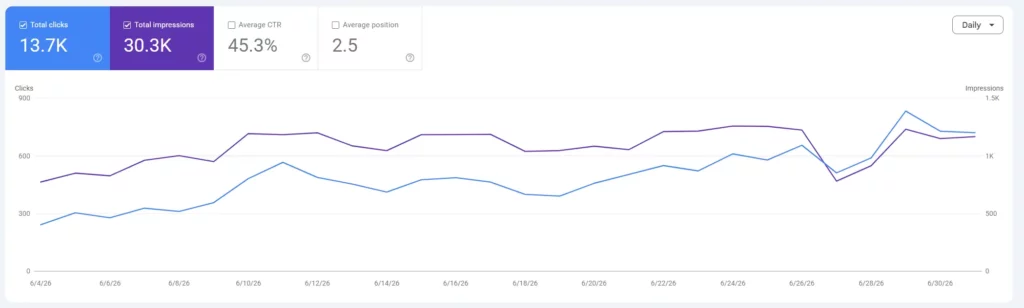
A 45.3% CTR showed that users were not just seeing the pages in search results. They were clicking because the pages matched what they were looking for. The average position of 2.5 was especially important. It showed that the campaign was not relying on low-ranking long-tail visibility. The pages reached high positions quickly, which is exactly what a short Parasite SEO campaign needs to generate revenue within one month.
Why the Campaign Worked
The campaign worked because it had a clear commercial goal. We did not try to build a large website or wait months for a new domain to gain trust. Instead, we used high-authority websites that already had ranking power and focused only on pages that could bring traffic and revenue quickly. The strongest results came from Malaysia-focused keywords, fast-ranking authority placements, simple on-page improvements, link support for pages that were already moving, and daily performance tracking. This made the campaign fast, focused, and easy to measure, with every part built around one goal: ranking pages quickly and turning organic clicks into affiliate revenue.
Conclusion
This Parasite SEO campaign proved that a small-budget affiliate test can still produce strong returns when the strategy is focused. In 30 days, the project turned $120 into $4,800, reached more than 13,200 organic clicks, and secured Top 3 rankings for 18 keywords. The campaign succeeded because it used the right shortcut without losing discipline. High-authority placements created the ranking opportunity, but keyword research, on-page work, CTR optimization, authority links, and daily tracking turned that opportunity into revenue. For the Malaysian affiliate market, the result was clear: SEO did not need a large budget to work fast. It needed the right pages, the right keywords, and fast execution.