

eSports SEO services help betting operators, affiliates, publishers, teams, and tournament organisers gain qualified organic traffic. Search demand changes quickly around fixtures, roster moves, patches, qualifiers, and major competitions. SEO work must connect technical accessibility, current content, keyword mapping, and accurate event data with measurable acquisition goals.
SEO Rockets builds search programs around game titles, teams, players, tournaments, betting markets, and regional audiences. Work covers technical SEO, content production, internal linking, mobile performance, multilingual architecture, Digital PR, and reporting. Campaign priorities are tied to rankings, organic sessions, registrations, affiliate clicks, deposits, or other agreed conversion events.
What Is SEO for eSports Websites?
eSports SEO is search optimisation built for websites covering competitive gaming, betting markets, tournaments, teams, players, and live match information. It differs from general SEO because demand changes around events, terminology varies by game, and many projects serve several countries. Match pages also depend heavily on live feeds and JavaScript. Search-critical information should remain accessible through rendered HTML, structured data, stable URLs, and current sitemaps.
Key technical signals:
- Real-time indexability of match, tournament, and odds pages.
- SportsEvent or Event structured data for relevant competition pages.
- Canonical handling for filters, parameters, duplicate match routes, and archives.

| Audience | Primary Intent |
| Fans / bettors / media | Scores and schedules / odds and markets / reports |
Use JSON-LD where supported. Matches can be represented with SportsEvent or Event; players should use Person. Avoid inventing unsupported Match or Player schema types. JavaScript-heavy interfaces may require SSR or prerendering. International projects also need hreflang, stable canonicals, and accurate Open Graph and social metadata.
Who Our eSports SEO Services Are For
Our eSports SEO services support businesses that depend on recurring gaming searches rather than static evergreen demand. The campaign model changes according to publishing speed, available data feeds, conversion goals, CMS limits, and market coverage.
- Betting operators and affiliates: capture commercial match traffic and improve registrations or affiliate conversions.
- Gaming publishers: expand search visibility while maintaining fast editorial output.
- Teams and tournament organisers: rank schedules, player pages, results, and branded event assets.
- SEO and marketing teams: add technical, editorial, and authority resources to an existing operation.
| Audience | Primary KPIs | Starter Scope |
| Betting / affiliates | Registrations, clicks, FTDs | Technical + commercial pages |
| Publishers | Organic sessions, indexed stories | Editorial SEO |
| Teams / organisers | Branded visibility, event traffic | Entity + event SEO |
| Marketing teams | Rankings, conversions | Audit + backlog |
Projects normally require analytics access, Search Console, CMS permissions, and documentation for relevant match or betting feeds.
eSports Betting Landing Page Architecture
Betting projects need pages that respond quickly to fixture demand while supporting pre-match, live, and post-match intent.
Operational Checklist
- Configure GA4 and server-side events where required.
- Standardise UTM naming across paid, affiliate, and partner traffic.
- Audit affiliate redirects and tracking parameters.
- Connect approved live odds feeds without exposing sensitive credentials.
Commercial Integration Scope
-
Odds & Markets
Dynamic connection to pre-match and in-play market data.
-
Match Data
Real-time statistics and fixture schedule response.
-
Responsible Betting
Integrated safe play resources and protection directives.
-
Regulatory Compliance
Alignment with local licensing requirements and terms.
Live Betting Page Performance Drivers
Particularly critical factors for high-concurrency live match environments:
Competitive Gaming News and Content Platforms
Gaming publishers depend on publication speed, factual accuracy, searchable archives, author pages, and clear timestamps. Editorial SEO should define templates before traffic spikes occur.
Recommended cadence:
- Breaking news: publish immediately after verification.
- Match reports: publish during or directly after events.
- Analysis: publish around roster, patch, or tournament interest.
- Long-form features: maintain evergreen topic coverage.
| Content Type | Typical Length | Structured Data |
| News | 400–800 words | Article / NewsArticle |
| Live coverage | Rolling | LiveBlogPosting |
| Event page | Variable | Event / SportsEvent |
Templates need self-referencing canonicals, visible datePublished and dateModified values, stable URLs, and archive rules that prevent duplicate pagination.
eSports Teams and Tournament Organisers
Teams and organisers need permanent pages for rosters, players, fixtures, results, sponsors, venues, and tournament stages. These pages often become primary branded search destinations.
Page template checklist:
- Player biography and current role.
- Verified roster status and statistics.
- Match history and upcoming fixtures.
- Sponsor disclosures where applicable.
Technical setup should use Person for players, SportsTeam where suitable, and SportsEvent or Event for tournaments and matches. Multi-country tournament pages should use correct hreflang pairs and self-referencing canonicals.
What Makes eSports Search Different
Competitive gaming search demand changes faster than most editorial categories. Interest can rise within hours after a draw, roster change, patch release, or tournament result. Vocabulary is also fragmented across game titles and communities, while international tournaments create simultaneous demand in several languages.
Editorial tactics:
- Build reusable event and match templates.
- Maintain evergreen game, team, and tournament resources.
- Create separate multilingual hubs for priority markets.
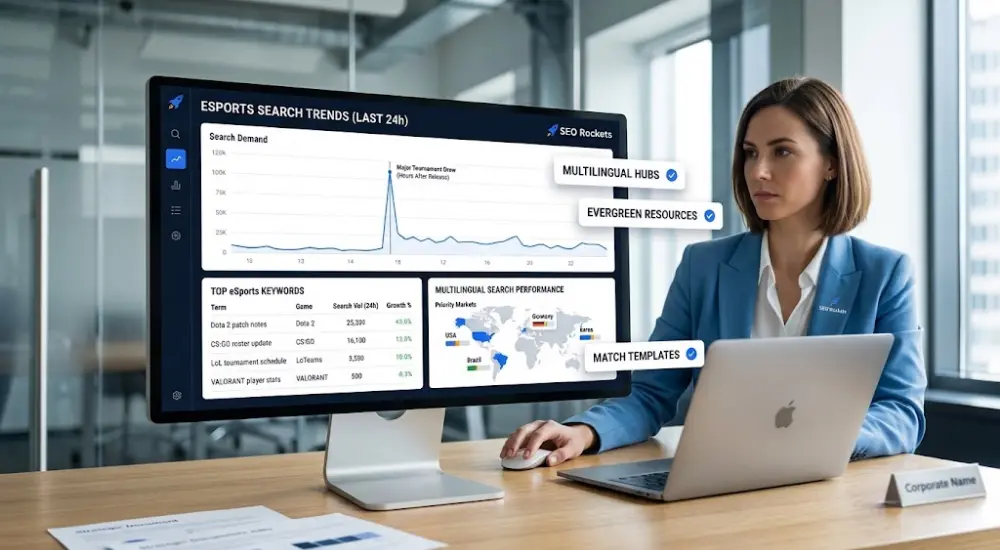
Technical planning should support frequently refreshed XML sitemaps, fast discovery of new URLs, and language-specific canonical and hreflang rules.
Changing Demand Around Matches and Tournaments
Tournament queries often rise before a fixture, peak around live play, then move toward results, highlights, recaps, and next-round searches. Content production should follow that lifecycle.
- Publish a pre-event page using a prepared template.
- Add verified live information without changing the primary URL.
- Convert the page into a useful post-match resource.
Invalidate stale cache entries when scores or schedules change. Update sitemap lastmod values only after meaningful page changes. Track query movement through Search Console, analytics events, internal search data, and live traffic telemetry.
Game-Specific Keywords and Community Terminology
Keyword research must reflect how players actually discuss each title. Search sets may contain champion names, heroes, weapons, maps, patch numbers, tournament abbreviations, roster slang, meta terminology, and betting-specific phrasing.
| Term Group | Intent | Priority | Example Page |
| Team + match | Transactional | High | Match page |
| Patch + hero | Informational | Medium | Patch analysis |
| Tournament + odds | Commercial | High | Betting page |
Seed terms can come from internal site search, community forums, video comments, streaming discussions, analytics, and SERP analysis. Related wording and contextual synonyms should support coverage without repetitive keyword placement.
Audiences Across Languages & Markets
International eSports SEO requires local search mapping rather than direct translation. Game terminology, betting vocabulary, tournament names, and commercial intent may differ between countries even when users follow the same title.
Localization Checklist
- Translate meaning, then adapt terminology to local usage.
- Map country-specific search intent separately.
- Review local SERP formats and competitors.
Technical Architecture
- Reciprocal hreflang references across localized pages.
- Consistent canonical tags to avoid regional indexation conflicts.
- Regional content ownership and CDN delivery for the target audience.
| Market | Priority Content | Technical Setup |
|---|---|---|
| Local language market | Fixtures, teams, betting pages | hreflang + local URLs |
| International English | Major events, guides | Global hub + CDN |
What Our eSports SEO Services Include
SEO Rockets combines technical analysis, search research, editorial planning, on-page work, internal linking, mobile optimisation, link acquisition, and Digital PR. Each workstream is tied to measurable search or conversion indicators.
- Technical audits: crawl, rendering, indexation, logs, sitemaps, and page speed.
- Keyword research: game, event, team, player, and betting clusters.
- Content planning: event calendars, templates, briefs, and refresh cycles.
- On-page SEO: metadata, headings, structured data, links, and HTML corrections.
- Performance: rendering, caching, CDN, images, and server response.
- Authority work: publisher outreach, digital assets, interviews, and PR.

| Service | Deliverable | KPI |
| Technical SEO | Prioritised backlog | Indexed priority URLs |
| Content | Keyword map + briefs | Organic sessions |
| Authority | Acquired placements | Referring domains |
| Analytics | Event framework | Conversion rate |
Measurement can use GA4 events, Search Console data, ranking sets, server-side events, and acquisition funnels.
Technical Audits and Website Optimisation
Technical audits identify obstacles that stop search engines from discovering, rendering, indexing, or prioritising useful eSports pages.
Audit sequence:
- Crawl all indexable templates.
- Compare indexed and canonical URL sets.
- Inspect server logs and bot activity.
- Test JavaScript rendering.
- Review XML sitemaps.
- Measure Core Web Vitals.
- Prioritise fixes by traffic and revenue impact.
| Issue | Severity | Fix | Owner |
| Match data absent from HTML | High | SSR/prerender | Development |
| Duplicate parameters | Medium | Canonical rules | SEO |
Performance checks should cover LCP, INP, CLS, TTFB, HTTP/2 or HTTP/3 support, Brotli compression, and WebP or AVIF delivery.
Keyword Research & Competitor Analysis
Keyword strategy should follow event cycles instead of relying only on static monthly volumes.
Research Coverage Areas
| Keyword Group | Intent | Priority | Example URL |
|---|---|---|---|
| Team vs team | Event | High | /matches/ |
| Tournament odds | Commercial | High | /betting/ |
| Player stats | Informational | Medium | /players/ |
Content Planning for Games Teams and Events
Content calendars should connect predictable tournament dates with reactive publishing. Each template needs a clear publishing owner and update policy.
- Pre-match previews: 600–1,000 words before major fixtures.
- Live pages: rolling verified updates.
- Post-match reports: 500–900 words.
- Player profiles: evergreen pages with scheduled reviews.
- Patch analysis: publish after confirmed release information.
- Betting guides: refresh before major tournament stages.
| Title | Purpose | Target KW | CTA |
| Team A vs Team B | Match intent | team a vs team b | View markets |
Editorial SOPs should define source verification, timestamps, corrections, update ownership, and expiry rules.
On-Page SEO and Internal Linking
On-page work controls how each URL communicates intent. Titles, H1–H2 structure, meta descriptions, descriptive alt text, schema markup, and visible data blocks should match the page purpose.
Example headings:
- Team A vs Team B Match Preview
- Tournament Schedule and Results
- Player Statistics and Recent Matches
| Page Type | Internal Links | Anchor Policy |
| Match | Teams, event, relevant market | Descriptive |
| Team | Players, fixtures, tournament | Mixed natural |
| Guide | Commercial and supporting pages | Contextual |
Use self-referencing canonicals for valid pages. Google no longer relies on rel=”prev” and rel=”next” as indexing signals, so archives need crawlable pagination and stable internal links. Reserve layout space for ads and widgets to reduce CLS.
Mobile Performance & Page Speed
Mobile eSports traffic often reaches pages during live matches, making latency and interaction delays costly.
Priority Actions
- Reduce slow backend queries.
- Cache reusable match data.
- Compress text with Brotli.
- Serve WebP or AVIF images.
- Defer non-critical scripts.
Performance Infrastructure
| Issue | Diagnostic Tool | Fix |
|---|---|---|
| High LCP | CrUX / Lighthouse | Reduce hero payload |
| Poor INP | DevTools | Reduce main-thread work |
| High TTFB | Server telemetry | Cache/backend fixes |
Link Building and Digital PR
Authority work should focus on relevant publications, tournament coverage, interviews, statistics, and useful data assets rather than bulk placements.
Tactics include journalist outreach, team interviews, tournament reports, original data summaries, and co-marketing with gaming publishers.
| Link Type | Typical Authority Level | Outreach Angle |
| Gaming publisher | Medium–high | Data or interview |
| Team site | Relevant niche | Partnership |
| News publication | High | Timely research |
Avoid private link networks and repetitive anchors. Review suspicious referring domains before deciding whether any disavow action is necessary.
Common SEO Issues We Address
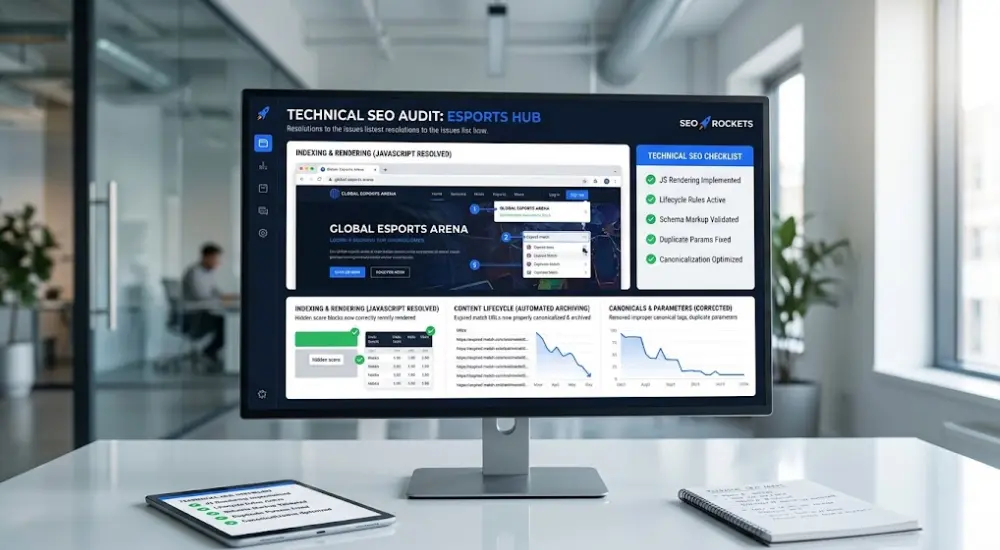
Frequent eSports SEO problems appear when websites publish thousands of event URLs without lifecycle rules. Other sites render important information only after JavaScript execution or fail to connect analytics with live content.
Content lifecycle issues:
- Expired match pages with no useful archive value.
- Thin recaps.
- Repeated tournament templates.
Indexing and rendering issues:
- Duplicate parameters.
- Hidden score or odds blocks.
- Incorrect canonical tags.
Tracking gaps:
- Missing server-side events.
- Broken affiliate attribution.
- Inconsistent conversion naming.
| Issue | Impact | Quick Fix |
| Hidden JS data | Weak crawl visibility | SSR/prerender |
| Thin archives | Index bloat | Consolidate/noindex |
Outdated Match Pages and Tournament Archives
Old match URLs should retain value only when they answer historical intent. Consolidate near-duplicates, preserve useful results pages, and build structured tournament archives with dates and season context.
Archive process:
- Classify active, historical, duplicate, and thin URLs.
- Consolidate repeated pages where appropriate.
- Keep useful history accessible through internal links.
- Remove expired URLs from priority sitemaps.
| Archive Type | Action | Retention |
| Major tournament | Keep indexed | Long term |
| Thin duplicate | Merge/noindex | Limited |
Duplicate Content Across Event Pages
Event templates often repeat introductions, rules, sponsors, and boilerplate. Each primary URL should contain unique match context, participants, timing, stage, data, and useful commentary.
| Page Type | Unique Content Requirements | Structured Data Schema |
|---|---|---|
| Match | Unique matchup context; score, roster, schedule | SportsEvent |
| Tournament | Unique event summary; stages, teams, dates | Event |
| Team | Roster and recent fixtures | SportsTeam |
| Player | Biography and statistics | Person |
Important Match Information Hidden from Search Engines
Scores, lineups, schedules, and odds should not exist only inside client-side widgets that require several API calls after page load. Search-critical data should be available in rendered HTML or through reliable server rendering.
Developer checklist:
- Render primary match content server-side or through prerendering.
- Add valid structured data.
- Include priority URLs in XML sitemaps.
- Confirm robots rules allow required resources.
| Hidden Scenario | Recommended Fix |
| JS-only scoreboard | SSR HTML snapshot |
| Login-gated public schedule | Public indexable summary |
How We Run Your eSports SEO Campaign
Campaign work moves from discovery into auditing, implementation, measurement, and recurring prioritisation. Development, editorial, analytics, and marketing teams receive a shared backlog.
- Discovery: define markets, revenue goals, and constraints.
- Audit: identify technical and content gaps.
- Pilot: test priority templates and clusters.
- Scale: expand validated workstreams.
- Ongoing: track performance and refresh priorities.

| KPI | Baseline | Target | Measurement |
| Organic sessions | Current | Agreed | GA4 |
| Indexed pages | Current | Agreed | Search Console |
| Conversions | Current | Agreed | GA4/server events |
Implementation normally requires development access, analytics, CMS permissions, and the editorial calendar.
Understanding Your Website and Business Goals
Discovery connects technical work with commercial outcomes. We review stakeholders, markets, product priorities, analytics, architecture, publishing workflows, and data-feed dependencies.
Required inputs:
- Primary site and target markets.
- GA4 and Search Console access.
- CMS or staging access.
- Match, tournament, or odds-feed documentation.
- Existing keyword and content plans.
The initial deliverables are an audit report, issue register, opportunity map, and prioritised implementation backlog.
Building and Implementing Your SEO Strategy
Strategy converts audit findings into keyword clusters, technical tickets, editorial schedules, internal-link plans, and authority tasks.
Priority Execution Order
- Resolve blocking crawl and rendering faults.
- Repair canonical and indexation rules.
- Improve high-value existing pages.
- Publish missing commercial and event clusters.
- Build supporting authority.
Strategy Conversion Assets
| Sprint | Tasks | Owner | ETA |
|---|---|---|---|
| Sprint 1 | Indexing + rendering | Dev/SEO | Agreed |
| Sprint 2 | Content + links | SEO/editorial | Agreed |
Tracking Results and Refining Priorities
Reporting connects rankings with user behaviour and business outcomes. Useful measurements include GA4 funnels, server-side conversion events, Search Console clicks, ranking sets, affiliate conversions, and user cohorts.
Reporting cadence:
- Weekly: technical incidents and priority rankings.
- Monthly: traffic, conversions, content, and links.
- Quarterly: market allocation and strategy review.
| Metric | Current | Change | Notes |
| Organic clicks | Updated monthly | % | Search Console |
| Conversions | Updated monthly | % | Analytics |
Our iGaming SEO Case Studies
134,000 Organic Clicks in 3 Months
One SEO Rockets project required technical cleanup, stronger content coverage, improved metadata, internal linking, and authority work. The campaign recorded 134,000 organic clicks and 3.29 million impressions across 3 months, with a 4.1% CTR and average position of 9.6.
| Metric Before | Metric After | Timeframe |
| Existing organic visibility | 134,000 clicks | 3 months |
Technical work covered indexation, crawl depth, canonicals, sitemaps, redirects, content restructuring, and contextual internal links.
Sports Betting SEO Performance
A sportsbook project started with limited SEO contribution to acquisition and achieved scaled organic growth following systematic technical and content optimization.
Core Operational Drivers
Why Choose SEO Rockets for eSports SEO
SEO Rockets works across technical SEO, gaming content, event-led search, authority acquisition, and conversion measurement. The service model suits sites where rankings depend on frequent publishing and technically complex page templates.
Proof points:
- Technical audits covering indexation, rendering, logs, and performance.
- Content systems for events, commercial pages, and editorial clusters.
- Digital PR and link acquisition for competitive gaming and betting topics.
- Reporting tied to traffic and acquisition metrics.
Measured project example: a sportsbook SEO campaign increased monthly organic clicks from 22,000 to 127,000 across 10 months.
Discuss Your eSports SEO Project
Request an initial SEO review to identify technical faults, missed keyword groups, weak templates, and content opportunities across your games, events, markets, and commercial pages.
Next steps:
- Free initial audit.
- Discovery call with SEO and business stakeholders.
- Prioritised proposal based on technical and commercial impact.
| Pages Audited | Quick Wins | Timeline |
| Priority templates and key URLs | Technical, content, internal links | Confirmed after access |
Contact form fields: site URL, target markets, current monthly organic traffic, priority games, primary conversion goals.
The output includes technical diagnostics, opportunity areas, and a prioritised roadmap for implementation.