

CPA SEO Services help affiliate businesses capture commercial search demand and convert organic visits into tracked leads. SEO Rockets works with CPA networks, publishers, lead-generation websites, and performance teams. Our work covers search demand, landing pages, technical SEO, content production, authority building, and conversion measurement. Every campaign connects rankings with measurable business actions rather than traffic alone.
CPA websites require different SEO priorities from standard informational projects. Offers change quickly, tracking must remain accurate, and landing pages need commercial intent. We structure campaigns around qualified search traffic, controlled indexation, reliable attribution, and conversion-focused pages. Technical audits, content updates, internal linking, and reporting work as one operating system for organic acquisition.
What Is SEO for CPA Networks and Affiliate Websites?
CPA SEO is search optimisation built around acquisition actions rather than pageviews. It serves CPA networks, affiliate programmes, publishers, lead-generation websites, performance marketers, and in-house SEO teams. Commercial pages target users already comparing offers, checking terms, or preparing to convert. Tracking, offer freshness, and index control therefore carry more weight than on conventional publishing websites.
Key technical signals include:
- Server-side conversion tracking for resilient lead attribution.
- UTM and attribution standards for consistent campaign reporting.
- Canonical rules for duplicate or parameter-based offer URLs.
| Audience | Primary Intent |
| CPA networks | Scale active offers and qualified conversions |
| Affiliates | Convert commercial organic traffic into leads |

GA4 events should use stable naming rules. Server-side tagging can reduce data loss from browser restrictions. Multi-market pages require accurate hreflang references. Offer variants need canonical control. Social landing pages also benefit from Open Graph and Twitter Card metadata. Titles should match the page intent, while descriptions should state the offer category, audience, and commercial value without keyword stuffing.
How SEO Supports CPA Marketing
SEO attracts people already searching for products, comparisons, reviews, eligibility requirements, or specific offers. Keyword clustering separates informational demand from commercial intent and assigns each cluster to a suitable landing page.
Reviews, comparisons, calculators, and how-to pages can pre-qualify users before they reach the conversion step. Stronger alignment between query intent and page content usually produces cleaner lead quality than untargeted traffic acquisition.
Main tactical outcomes include:
- Higher visibility for search terms linked to conversion intent.
- Better lead quality through pre-qualified organic visitors.
- Lower cost per lead over longer acquisition periods.
- Scalable traffic from pages that retain recurring search demand.
Measurement should connect rankings with completed actions. Server-side event capture, disciplined UTM rules, and conversion deduplication reduce attribution errors. GA4 and BigQuery can then segment leads by landing page, device, market, offer category, cohort, and customer value.
Common SEO Challenges for CPA Websites
CPA websites often face strong commercial competition, unstable offer inventories, duplicate landing pages, and fragmented tracking. These problems affect crawl efficiency, rankings, reporting accuracy, and conversion value.
-
Competition and Authority
- Commercial SERPs often contain established publishers and high-authority brands.
- Weak link profiles limit ranking growth for purchase-ready queries.
-
Content Freshness & Duplication
- Offer changes can leave expired pages indexed.
- Similar review templates can create weak page differentiation.
-
Tracking and Attribution
- Browser-only events may lose part of the conversion path.
- Duplicate postbacks can inflate reported lead volume.
| Challenge | Impact | Quick Fix |
|---|---|---|
| Offer duplication | Split ranking signals | Canonicalize variants |
| Expired pages | Wasted crawl activity | Redirect, consolidate, or noindex |
| Tracking loss | Incomplete attribution | Add server-side conversion capture |
Competing for Keywords with Strong Conversion Intent
High-value CPA queries need stronger page differentiation than basic offer summaries. Pages should contain verified terms, qualification details, payout conditions, comparison data, original commentary, and useful conversion steps.
Priority checklist
- Map the query to a specific commercial intent.
- Add evidence unavailable on generic competitor pages.
- Improve mobile load speed and interaction stability.
- Use valid review or offer schema where applicable.
- Test CTA placement against measured conversion behavior.
| Asset | Owned Pages | Competitor Pages |
| Content depth | Measure unique data and intent coverage | Compare missing topics |
| Conversion elements | Review CTA visibility and form friction | Record competing flows |
| Backlink strength | Measure referring domains and anchors | Compare authority gaps |
Keeping Offer Pages Relevant and Updated
Offer freshness requires both editorial and technical controls. Dynamic content blocks can update payout values, dates, eligibility rules, or CTA labels without rewriting entire pages. Expired offers need predetermined archive rules.
Content operations should follow this sequence:
- Review active offers on a fixed schedule.
- Flag changed payouts, terms, or availability.
- Replace expired CTAs and outdated claims.
- Redirect, canonicalize, or noindex obsolete variants.
- Run QA on metadata, schema, links, and tracking.
| Offer State | Recommended Action | Meta Change |
| Active | Keep indexable | Update current terms |
| Replaced | Canonicalize or 301 | Point messaging to replacement |
| Expired | Redirect or noindex | Remove outdated commercial claims |
Turning Organic Traffic into Qualified Conversions
Organic traffic produces value only when users match the offer and complete measurable actions. CPA pages should pre-qualify visitors before sending them into a conversion funnel.
Pre-Qualification Framework
To maximize user matching and conversion rates, integrate essential qualification and trust touchpoints across your landing pages:
Useful Conversion Elements
- Eligibility checks
- Product comparisons
- Rate calculators
- Qualification questions
- Trust evidence
- Privacy details
- Visible disclosures
CRO Checklist
- Match CTA language to search intent.
- Track email captures and form starts.
- Reduce unnecessary fields.
- Record server-side conversion events.
- Integrate network or CRM postbacks.
- Validate duplicate-lead rules.
| Page Type | Primary CTA | Micro-Conversion |
|---|---|---|
| Review | Visit offer | CTA click |
| Comparison | Compare providers | Table interaction |
| Lead page | Submit application | Form start |
| Guide | Check eligibility | Tool completion |
What Our CPA SEO Services Include
SEO Rockets covers the technical, editorial, authority, and measurement work required for CPA growth.
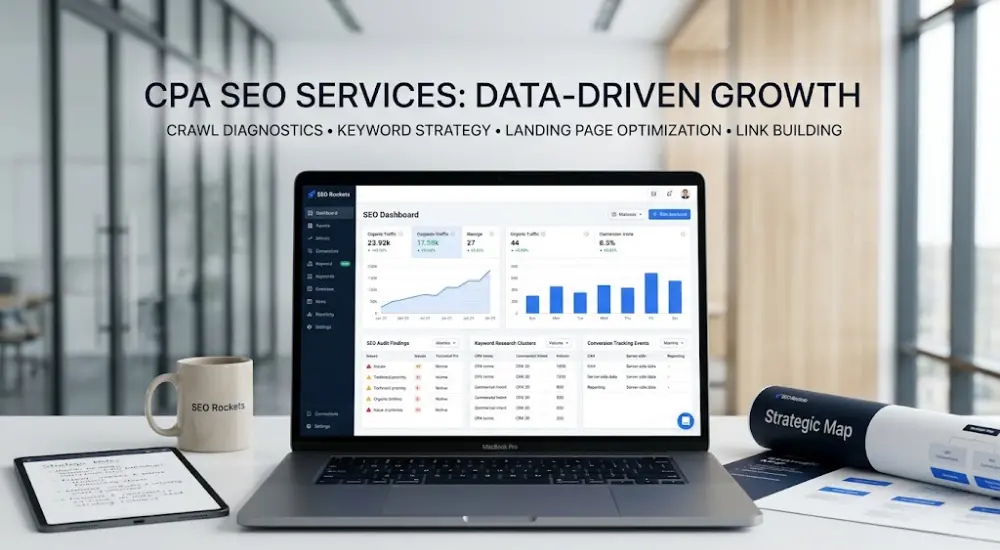
- SEO audits: crawl diagnostics, indexation checks, log analysis, content issues, and technical priorities.
- Keyword research: commercial clusters, comparison terms, review queries, and long-tail demand.
- Landing page optimisation: stronger intent matching, page structure, CTAs, metadata, and conversion paths.
- Content creation: offer pages, reviews, comparisons, case material, and FAQ content.
- Technical SEO: Core Web Vitals, canonicals, parameters, sitemaps, schema, rendering, and page speed.
- Link building: editorial placements, publisher outreach, Digital PR, and anchor monitoring.
- Conversion tracking: GA4 events, server-side tagging, postbacks, BigQuery exports, and reporting.
| Service | Deliverable | KPI |
| Audit | Technical backlog | Indexed pages, crawl errors |
| Keyword research | Search-intent map | Ranking coverage |
| Content | Commercial pages | Organic leads |
| Technical SEO | Fixed templates | CWV, crawl efficiency |
| Links | Referring domains | Authority growth |
| Tracking | Event architecture | Conversion accuracy |
Website Audits and Competitor Analysis
A CPA audit reviews technical health, index coverage, crawling, page quality, backlinks, competitors, and conversion measurement.
- Crawl all indexable templates.
- Review Search Console index coverage.
- Analyse server logs and crawl frequency.
- Test Core Web Vitals.
- Map competitor SERPs and content gaps.
- Compare backlink overlap.
- Prioritise issues by revenue impact.
| Issue | Severity | Fix | Owner |
| Duplicate offers | High | Canonical rules | Developer |
| Slow mobile LCP | High | Asset optimisation | Developer |
| Weak comparisons | Medium | Rewrite template | Content |
| Broken postbacks | High | Repair endpoint logic | Analytics |
Keyword Research and Landing Page Optimisation
Keyword research starts with commercial intent. Primary phrases should appear naturally, while semantic terms and long-tail variations broaden topical coverage without exact query repetition.
Intent Clustering Framework
Offer terms, review searches, comparison queries, alternatives, pricing searches, and problem-specific long tails should be clustered separately to ensure precise landing page alignment.
Useful Seed Sources
- Internal site search
- Affiliate conversion telemetry
- Competitor landing pages
- Paid search data
- Search Console queries
- CRM lead categories
| Keyword Group | Intent | Priority | Example URL |
|---|---|---|---|
| Offer category | Commercial | High | /offers/category/ |
| Review | Investigation | High | /reviews/brand/ |
| Comparison | Commercial | High | /compare/a-vs-b/ |
| How-to | Informational | Medium | /guides/topic/ |
Original Content for Offers, Reviews and Comparisons
CPA content must provide information beyond a copied offer summary. Reviews should explain terms, eligibility, conversion steps, restrictions, pricing, payout conditions, and user suitability.
Content plan
- Offer page: 600–1,000 words with current terms and CTA conditions.
- Review: 1,000–1,800 words with evidence, pros, cons, fees, and qualification rules.
- Comparison: 1,200–2,000 words with transparent criteria.
- Guide: length based on query scope and task complexity.
- FAQ: concise answers targeting real search questions.
| Title | Purpose | Target KW | CTA |
| Brand Review | Pre-qualify users | Brand review | Visit offer |
| A vs B | Compare options | A vs B | Compare terms |
| How to Apply | Explain process | Application query | Start application |
Structured review markup should reflect visible page content. Meta templates should contain the offer name, intent, and current value proposition.
Technical SEO and Internal Linking
CPA sites need disciplined URL control. Canonical tags should define preferred offer versions. Parameters must not create uncontrolled indexable combinations. XML sitemaps should contain useful canonical URLs only. Robots directives must protect crawl resources without accidentally blocking important pages.
Server-side rendering may be required when essential content depends on JavaScript. Image compression, reserved dimensions, efficient CSS, and reduced layout movement help lower CLS.
Optimised heading examples include Compare CPA Offers by Payout Model and Current Affiliate Programme Requirements.
| Page Type | Recommended Internal Links | Anchor Policy |
| Guide | Reviews and offers | Descriptive topical anchors |
| Review | Comparison pages | Brand plus intent |
| Category | Key offers | Commercial descriptive anchors |
| Comparison | Related reviews | Natural product names |
Paginated lists can use crawlable URLs with self-referencing canonicals. Internal links should connect category hubs, informational resources, and commercial pages.
Link Building and Digital PR
CPA link acquisition should focus on real publishers, relevant media, research assets, niche partnerships, and useful data resources.
Tactical Outreach Angles
Sustainable authority growth relies on value-driven publisher outreach and high-quality editorial placements:
- Original data pitches
- Publisher contribution proposals
- Broken-resource replacement
- Expert commentary
- Partner content collaborations
Profile Safety & Risk Control
Anchor distribution should remain natural. Link networks, bulk paid placements, and repetitive exact-match anchors create unnecessary risk.
| Link Type | Expected DR Range | Outreach Angle |
|---|---|---|
| Niche publisher | 20–50 | Relevant editorial contribution |
| Industry media | 40–70 | Data or expert commentary |
| Research citation | 30–70+ | Original statistics |
| Partner site | Variable | Commercially relevant collaboration |
Organic Conversion Tracking and Reporting
Tracking should connect organic entry pages with lead completion and network revenue. A practical stack can include GA4, server-side tagging, BigQuery, CRM records, and affiliate postbacks.
Tracking checklist
- Define event names.
- Document required parameters.
- Configure server endpoints.
- Test browser and server events.
- Deduplicate repeated conversions.
- Validate postback responses.
- Reconcile platform data with CRM totals.
| Metric | Definition | Data Source | Frequency |
| Organic leads | Completed leads from organic sessions | GA4/CRM | Weekly |
| Conversion rate | Leads divided by qualified sessions | GA4 | Weekly |
| Revenue per lead | Revenue divided by accepted leads | CRM/network | Monthly |
| Accepted lead rate | Approved leads divided by submitted leads | Network | Monthly |
Every conversion path should be tested from landing page to final postback.
Who We Help with CPA SEO
CPA SEO requirements differ by business model.
- CPA networks and affiliate programmes: scale offer visibility and qualified publisher demand. Primary KPI: accepted conversions.
- Affiliate publishers: grow commercial traffic and improve revenue per visitor. Primary KPI: organic revenue.
- Performance teams: connect search traffic with lead economics. Primary KPI: cost and value per lead.
- In-house SEO teams: add specialist technical and affiliate support. Primary KPI: implementation velocity.

| Audience | Primary KPIs | Recommended Starter Package |
| CPA network | Leads, approvals | Technical audit + tracking |
| Publisher | Revenue, CVR | Content + landing pages |
| Performance team | CPL, LTV | Attribution + SEO |
| SEO team | Rankings, backlog delivery | Audit + implementation |
Analytics access, CMS permissions, and postback documentation should be available before implementation begins.
CPA Networks and Affiliate Programmes
CPA networks need scalable offer templates, publisher-facing search visibility, and accurate conversion records.
Integration checklist
- Secure postback endpoint.
- Standard offer parameters.
- Reporting API access.
- Stable campaign IDs.
- Deduplication rules.
- Canonical URL policy.
Postback requests should use protected endpoints. Offer parameters need documented naming conventions. Reporting should aggregate conversions without losing offer-level detail.
Affiliate Publishers and Lead Generation Websites
Affiliate publishers need pages that combine editorial value with commercial clarity to maximize traffic potential and user trust.
Review Template Elements
Review templates should maintain high editorial integrity while providing essential commercial details:
Essential Components
- Verified terms
- Pros and cons
- Payout information
- Conversion steps
- Disclosures
- Clear CTA logic
Useful Monetisation-Aware Tactics
- Comparison tables
- Structured review markup
- CTA event tracking
- Revenue-based page prioritisation
- Internal links from informational pages
- Faster mobile forms
Our iGaming SEO Case Studies
Verified client performance data should be used before publishing this section. The format below can be populated from approved SEO Rockets reporting rather than fabricated metrics.
Case Study 1 — Affiliate Content Restructuring: Challenge: weak commercial page coverage. Solution: rebuild query clusters, revise landing pages, and add internal links. Technical notes should name the audit method, schema changes, page templates, and GA4 events used.
| Metric | Before | After | Timeframe |
| Organic clicks | Verified client data | Verified client data | Verified period |
| Leads | Verified client data | Verified client data | Verified period |
Case Study 2 — Technical Offer Cleanup: Challenge: duplicate and expired offer URLs. Solution: canonical rules, redirect mapping, pruning, sitemap cleanup, and crawl monitoring.
| Metric | Before | After | Timeframe |
| Indexed offer URLs | Verified client data | Verified client data | Verified period |
| Conversion rate | Verified client data | Verified client data | Verified period |
How We Manage Your CPA SEO Campaign
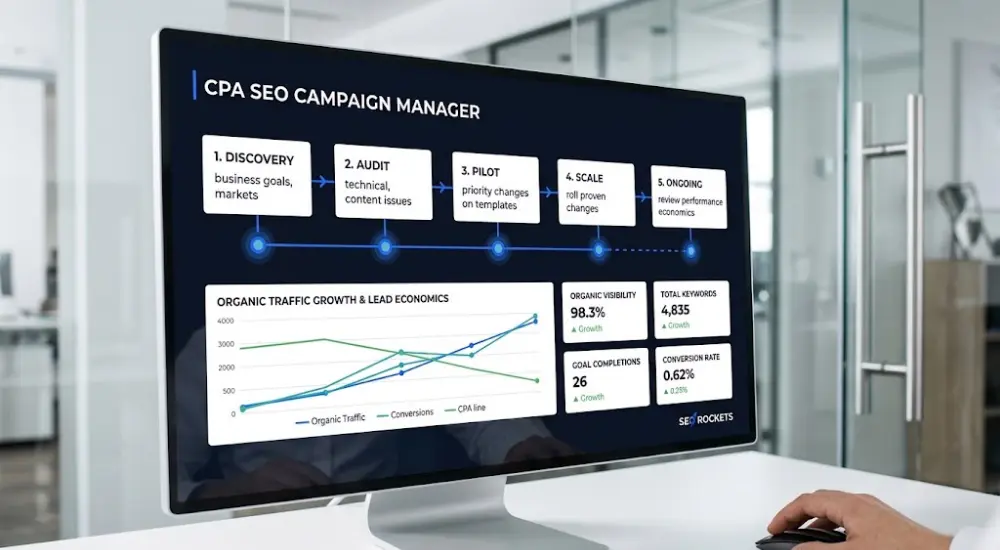
Each engagement moves through a controlled implementation cycle.
- Discovery: define business goals, markets, offers, and KPIs.
- Audit: identify technical, content, authority, and tracking issues.
- Pilot: test priority changes on selected templates.
- Scale: roll proven changes across larger page groups.
- Ongoing: review performance, offers, crawling, and lead economics.
| KPI | Baseline | Target | Measurement Method |
| Organic leads | Current value | Agreed target | GA4 + CRM |
| Conversion rate | Current value | Agreed target | GA4 |
| Indexed pages | Current value | Healthy range | Search Console |
| Revenue per lead | Current value | Agreed target | CRM/network |
Implementation requires developer access, analytics permissions, an editorial calendar, and postback documentation.
Setting Goals and Reviewing Your Website
Discovery establishes the measurement baseline and technical scope.
Required inputs include:
- Site URL.
- GA4 access.
- Search Console access.
- Server-side tagging details.
- CMS permissions.
- Current offer inventory.
- Postback documentation.
Deliverables include a technical audit, prioritized backlog, content opportunity map, measurement plan, and ownership matrix.
Developing and Implementing Your Strategy
Strategy converts audit findings into an ordered implementation plan. Commercial keyword clusters define landing-page priorities, technical issues enter the developer backlog, content gaps become editorial briefs, and authority gaps feed outreach planning.
Priority Actions
- Repair tracking defects.
- Fix critical crawl and indexation issues.
- Rebuild high-value landing pages.
- Publish missing commercial content.
- Strengthen internal links.
- Begin targeted authority acquisition.
Execution Governance
Structured sprint allocation guarantees clear accountability across development, content, and outreach teams while maintaining rigorous quality control.
| Sprint | Tasks | Owner | ETA |
|---|---|---|---|
| 1 | Tracking and index fixes | Dev/Analytics | Agreed sprint |
| 2 | Landing page templates | SEO/Content | Agreed sprint |
| 3 | Content rollout | Editorial | Agreed sprint |
| 4 | Links and PR | Outreach | Ongoing |
Measuring Results and Improving Performance
Performance reviews should connect organic visibility with commercial outcomes. Ranking sets show search growth. GA4 funnels show behavioral loss points. Server events validate conversions. CRM and network data show lead quality and payout value.
Recommended reporting cadence:
- Weekly: crawling, indexation, tracking errors, priority rankings.
- Monthly: traffic, leads, conversion rate, revenue, backlinks.
- Quarterly: cohort quality, LTV, market expansion, content priorities.
| Metric | Current | Change | Notes |
| Organic sessions | Current data | Period change | Traffic quality |
| Leads | Current data | Period change | Accepted vs rejected |
| CVR | Current data | Period change | Landing page impact |
| Revenue | Current data | Period change | Network reconciliation |
Attribution should be checked against postbacks and payout records.
Why Choose SEO Rockets for CPA SEO?
SEO Rockets focuses on CPA, affiliate, and performance-led search projects where traffic must connect to measurable commercial actions. Campaigns combine technical SEO, conversion tracking, content operations, offer-page management, and authority growth.
Proof points should use verified internal records, including:
- Team credentials and sector experience.
- Platforms and tools used.
- Audit depth.
- Schema implementations.
- Server-side tracking projects.
- Confirmed client outcomes.
Verified KPI box: add an approved metric from an existing SEO Rockets case study, with market, timeframe, baseline, and result.
Discuss Your CPA SEO Project
Request a free audit or discovery call to identify technical issues, organic growth opportunities, and conversion-tracking gaps.
Next steps:
- Free audit: initial technical and commercial review.
- Discovery call: discuss markets, offers, traffic, and objectives.
- Tailored proposal: receive a prioritized working scope.
| Pages Audited | Quick Wins | Estimated Timeline |
| Priority commercial and technical templates | Indexation, tracking, content, speed | Defined after initial review |
Contact form inputs: site URL, target markets, monthly organic traffic, primary offers, current tracking setup, and desired KPIs.
The review should return technical diagnostics, commercial priorities, and an implementation roadmap.