


This case study shows how a focused SEO campaign helped a website reach 134,000 organic clicks and 3.29 million Google impressions in three months. The project finished the period with a 4.1% CTR and an average position of 9.6, which means the site did not just appear more often in search results. It also started collecting a steady volume of real organic traffic.
The growth came from a mix of technical SEO, content updates, keyword expansion, internal linking, and link building. There was no single “big win” behind the result. The campaign worked because several SEO problems were fixed at the same time, and the strongest pages received more support from both content and links.
Main SEO Results
| Metric | Result |
|---|---|
| Organic clicks | 134,000 |
| Google impressions | 3.29 million |
| Average CTR | 4.1% |
| Average position | 9.6 |
| Average clicks per month | 44,600+ |
| Average impressions per month | 1.09M+ |
| Estimated clicks per day | 1,480+ |
| Estimated impressions per day | 36,500+ |
The numbers show a strong balance between visibility and performance. A site can get many impressions without meaningful traffic if rankings are weak or snippets are poor. In this case, the CTR reached 4.1%, which means the pages were visible enough and attractive enough to turn search impressions into visits.
Starting Point
Before the campaign, the website already had some SEO potential, but that potential was not fully used. Some pages were indexed and getting impressions, yet they were not bringing enough clicks. Other pages had weak structure, outdated sections, or missed important keyword groups completely.
The main issue was not one broken element. It was the combination of several small problems: pages were not deep enough, internal links were weak, metadata was too generic, and some valuable URLs were placed too far from the main site structure. Because of that, Google could see the website, but it did not always receive strong enough signals about which pages deserved better positions.
The first audit focused on finding pages with the best growth potential. These were mainly URLs that already had impressions but low CTR, pages ranking close to the first page, and topics where the website had no properly optimized landing page.
SEO Problems Found
The audit showed that the website had organic potential, but several SEO issues were slowing down growth. The problem was not one broken element. It was a mix of weak content signals, missing keyword coverage, poor internal support, and technical friction around important URLs.
Missing Keyword Clusters
Several important search groups had no dedicated pages. Because of this, the site was missing opportunities to appear for valuable commercial and informational queries.
Thin Existing Content
Some indexed pages were too short or too generic for competitive results. They needed stronger explanations, better structure, and clearer search intent coverage.
Weak Metadata
Some titles and meta descriptions were duplicated, vague, or not persuasive enough. This reduced the chance of turning search impressions into real clicks.
Poor Internal Linking
Priority pages were not supported well enough by related content. Useful pages existed, but they were not connected into a clear growth structure.
Technical Friction
Some important URLs were too deep in the structure or had weak crawl signals. This made it harder for search engines to process priority pages efficiently.
These issues are common on websites that already have content but do not yet have a clear SEO growth system. The site had useful assets, but they were not connected properly. That is why the campaign focused not only on creating new pages, but also on making existing URLs work harder through better structure, stronger content, and cleaner internal signals.
What Was Changed

The technical work came first. Important URLs were checked for indexation, crawl depth, canonical tags, metadata, broken links, redirects, and sitemap quality. The goal was simple: remove SEO friction and make sure that search engines could reach and understand the pages that mattered most. Content work followed after that. Existing pages were rewritten where needed, and missing keyword groups were covered with new pages. The main focus was search intent.
Every page had to answer the query better, not just contain more keywords. Short generic sections were replaced with clearer explanations, stronger headings, better examples, and more useful FAQ blocks where they made sense. Internal linking was also rebuilt.
Supporting articles were connected to commercial pages, related content was grouped into topic clusters, and important URLs received more contextual links. This helped both users and search engines move through the site in a more logical way.
SEO Work Breakdown
| SEO Area | What Was Done | Why It Mattered |
|---|---|---|
| Technical SEO | Indexation, metadata, sitemap, crawl depth, redirects | Helped Google process priority pages better |
| Content | Rewrites, new pages, better intent matching | Improved relevance and keyword coverage |
| Internal linking | Contextual links and topic clusters | Strengthened important URLs |
| Link building | Relevant external placements | Added authority to optimized pages |
| CTR optimization | Better titles and descriptions | Turned impressions into more clicks |
The strongest impact came from combining these actions. Technical fixes alone would not have created 134K clicks. Content alone would not have worked as well without internal links. Link building also performed better because the target pages were already improved before external authority was added.
Three-Month Growth Logic
The campaign followed a staged SEO model rather than a random sequence of isolated tasks. In the first month, the focus was on fixing the technical base and mapping the keyword landscape. During the second month, the main effort shifted to content improvements and internal linking. In the third month, link building and performance refinement helped push the strongest pages further. This order mattered because every stage prepared the site for the next one and made the overall growth path more stable.
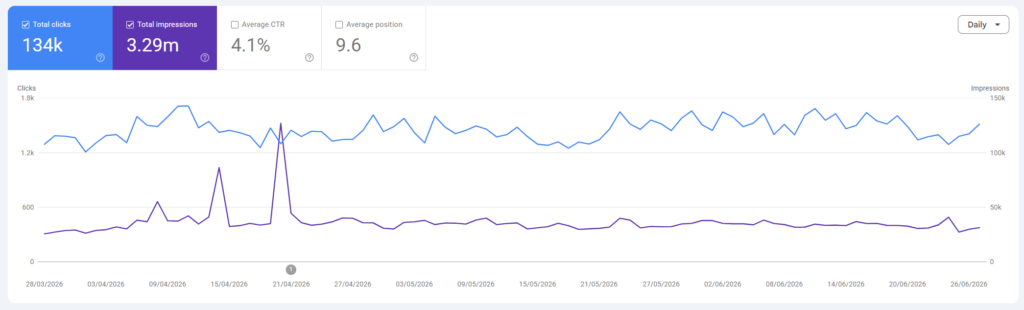
This sequence was important because it made the growth process more predictable. Pages with existing impressions first received better titles, clearer structure, and stronger content. New pages then expanded the site’s reach into missing keyword clusters, while internal links passed more relevance to priority URLs. Only after that did link building begin to support pages that already had ranking potential. By the end of the campaign, the project was generating around 44,600 clicks per month on average and more than 1.09 million monthly impressions, showing both wider visibility and stronger click performance.
Final Results
After three months, the project reached 134,000 organic clicks, 3.29 million impressions, 4.1% CTR, and an average position of 9.6. The average position was one of the most important signals in this case. It showed that many pages were moving close to the first page of Google results or already appearing there for valuable queries. The CTR also confirmed that the campaign improved more than rankings. Better snippets and stronger page relevance helped users choose the website from search results. With more than 36,500 impressions per day on average, even small CTR improvements could create a noticeable traffic increase.
Conclusion
This SEO case proves that fast organic growth is possible when the strategy is built around real search data, not random content production. The website already had potential, but it needed a cleaner structure, better content, stronger internal links, and more authority around priority pages. In three months, the project turned that potential into measurable growth: 134K clicks, 3.29M impressions, 4.1% CTR, and an average position of 9.6. The result came from a complete SEO system where every part supported the next one.