


The online gambling and betting space is brutally competitive, and standard optimization alone won’t keep you ahead. Every technical glitch on your platform costs you players and burns revenue. A full technical audit works like a diagnostic health check for your site, surfacing the infrastructure problems that stop search engine crawlers from indexing and ranking your most valuable pages.
What a Technical Audit Is and How We Run It
A real technical audit isn’t a quick scan from some free public tool. It’s a thorough architectural breakdown of your site’s backend, database efficiency, and server-side behavior. iGaming platforms don’t behave like ordinary blogs or static online stores. They run on highly volatile environments where pages constantly pull and push live data: in-play betting odds, API-driven casino game feeds, localized bonus structures that shift by region, and changing payment gateways.
All of that data movement leaves a heavy footprint of bulky JavaScript, endless URL parameters, and constant database queries. Left unoptimized, this load strains your server and quietly eats through your search engine crawl budget. If Googlebot exhausts itself wrestling with broken scripts or infinite loops, it gives up before it ever reaches your new, high-converting money pages. To prevent that, our dedicated iGaming SEO service splits the diagnostic process into four focused, hands-on phases.
Simulated Search Engine Crawls
We deploy advanced cloud-based crawlers set up to mirror exactly how Googlebot renders pages, on both desktop and mobile.
We crawl millions of URLs to map out your site’s real crawl frontier, flagging architecture bloat, orphaned landing pages, unindexed slot categories, and layout shifts.
We check localized regional mirrors, multi-language setups, and hidden staging environments to make sure no duplicate or staging code leaks into public search results.
Server Log File Analysis
A crawl tells us what can be found. Log analysis tells us what Googlebot is actually doing on your live server. We work through raw access logs across a 30-to-90-day window.
We track bot hits, response codes such as 3xx, 4xx, and 5xx, plus how often search crawlers return to key page groups.
We hunt crawl traps such as infinite affiliate tracking links and dynamic filter URLs where bots waste crawl budget instead of indexing core betting and casino review pages.
Real-Time Speed and Performance Benchmarking
A sluggish platform kills conversions and drags down mobile rankings. Instead of testing one page, we stress-test the whole infrastructure.
We dig into Core Web Vitals, including Interaction to Next Paint, Largest Contentful Paint, and Cumulative Layout Shift.
We measure performance under simulated peak traffic, so the platform stays fast and visually steady when thousands of users place live wagers during major events.
Technical Dev Spec Engineering
An audit is only as good as its implementation. The final phase turns diagnostic data into a clear execution plan.
We compile a clean, prioritized backlog that helps teams understand what should be fixed first and why it matters.
Every issue becomes a developer-ready ticket with the exact problem location, business impact, and clear how-to-fix specification for Jira or Trello.
What We Verify During a Technical Audit
iGaming platforms tend to pile up technical debt fast, which shows up as indexation bloat, duplicate affiliate tracking parameters, and JavaScript execution errors. For any long-term iGaming SEO strategy to hold up, every line of code has to pull its weight. Here’s what our audit checks across the board:
| Audit Focus Area | Issues Targeted and Resolved | Why It Matters for Performance |
|---|---|---|
| JS Rendering and Indexing | Broken interactive elements, hidden menus, and lazy-loading slot games | Makes sure Google indexes dynamic content instead of landing on a blank page |
| Duplicate Content and Parameters | Identical pages created by multi-currency settings, affiliate IDs, or UTM codes | Prevents keyword cannibalization and stops link equity from leaking away |
| Crawl Budget Optimization | Low-value utility pages that slip past or ignore robots.txt rules | Saves bot resources so your high-converting money pages get indexed sooner |
| Structured Data (Schema) | Misconfigured rich snippets for casino reviews, user ratings, and FAQs | Expands your SERP footprint and lifts click-through rates (CTR) |
Security and Clean Code: Catching Vulnerabilities Before Google Does
In online gambling, security isn’t just something for the IT team to worry about. It’s a core pillar of your search visibility. The moment a platform handles direct card payments, crypto gateways, and sensitive player identity checks (KYC), Google brings out its strictest YMYL (Your Money or Your Life) quality standards.
Search engines run security bots that crawl your site looking for weak spots. If Google spots a compromised framework, a single malicious link, or an unpatched flaw, it can stamp a “This site may be hacked” warning onto your SERP listing, which can wipe out more than 90% of your organic CTR within hours. In the worst cases, the domain gets blacklisted and scrubbed from the index entirely.

That’s exactly why serious SEO iGaming content work goes well beyond copywriting. It has to include deep code sanitization, server-hardening checks, and active defense against black-hat negative SEO from competitors who play dirty.
Scanning for Hidden Malicious Scripts and External Links in Your Code
Because iGaming platforms pull in serious revenue and carry heavy domain authority, they’re prime targets for automated hacking networks and injection attacks, day after day. Bad actors rarely deface a site in the open. Instead, they slip in silent scripts built to drain your link equity without you ever noticing. Our deep-code scanning protocol protects your domain reputation in layers:

- We review database tables, CMS files, active plugins, and themes to find suspicious code that may affect crawling, indexing, or site security, including base64-encoded functions, obfuscated PHP strings, and crawler-only conditional code hidden from regular visitors.
- We inspect old blog posts, casino review pages, and deep archive content for hidden outbound links. These links may be concealed with CSS tricks such as font size 0, off-screen positioning, or colors matching the background. We detect and remove them before they pass PageRank to unauthorized third-party networks.
- We check for arbitrary file upload issues and unauthenticated API endpoints that could let attackers or competitors add hidden doorway pages to your domain. These pages can generate spam URLs, steal organic traffic, and trigger Google manual penalties.
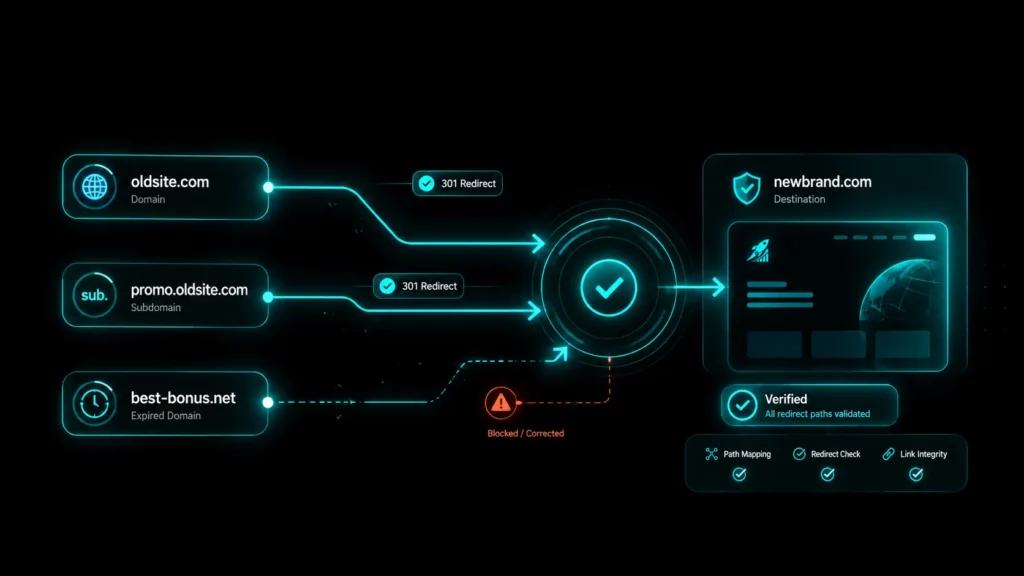
Verifying Correct Redirects When Moving to New Subdomains or Expired Domains
Growing your organic presence across markets calls for flexible site architecture. Whether you’re building Private Blog Networks (PBNs), spinning up localized subdomains for specific GEOs (say, bd.yourbrand.com or uz.yourbrand.com), or buying high-authority expired domains to fold their link juice into your main site, your routing has to be airtight. One wrong setting in your redirect logic can break backlink equity outright or trip algorithmic spam filters. During the audit, we go straight into your server configuration files (.htaccess, nginx.conf, or Cloudflare Page Rules) to check how your redirects actually behave:
- A temporary 302 tells search engines to keep the old URL indexed and hold back the link equity. A permanent 301 hands over close to 100% of the authority to the target page. We make sure your expired domain buys and structural moves all run on clean 301s, so you don’t lose a drop of link value.
- Over time, sites stack up layers of redirects (Page A to Page B to Page C). These chains slow load times and burn through crawl budget. Once a chain runs past three to five hops, Googlebot tends to abandon the crawl entirely. We map these chains and flatten them into direct, single-hop routes.
- We review how your server handles regional redirects. If it reroutes search bots by IP detection, Google may read it as cloaking (serving bots different content than users), which carries a harsh manual penalty. We keep your routing logic fully transparent to crawlers.
What You Get When the Audit Is Done
Plenty of agencies promise a technical audit and then hand you a generic 100-page PDF spat out by some off-the-shelf SaaS scanner. Those reports are stuffed with irrelevant data, false positives, and textbook definitions that leave owners confused and developers annoyed.
We work differently. What you get from us is an actionable, well-structured blueprint built around how your platform actually runs. We close the gap between high-level SEO thinking and real software engineering. Partner with us, and your iGaming SEO investment turns into concrete, high-impact deliverables aimed at moving you up the SERPs faster.
The Interactive Technical Priority Dashboard
Instead of a static document, you get access to a live, sortable view of your site’s health. We strip out the noise and organize every issue by severity, how hard it is to fix, and its real business impact.
- Critical: Problems that actively block indexing, damage link equity, or trigger security flags, such as server-side rendering failures, active redirect loops, or exposed staging sites.
- Medium: Structural gaps that cap your growth or inflate crawl budget, including weak Core Web Vitals, missing schema markup, and multi-language canonical mismatches.
- Low: Small hygiene issues, such as the odd 404 on a legacy blog post or missing image alt tags, that help polish overall technical performance.
Developer-Ready Technical Specifications
The hardest part of any technical SEO project is getting developers to actually make the changes. A vague ticket like “fix server response times” usually goes nowhere, so every error is translated into a clear technical blueprint.
- The exact lines of code, database tables, templates, or server files where the issue lives.
- A clear technical explanation of why the current setup is hurting bot indexation, crawling, rendering, or ranking performance.
- A concrete fix, such as precise Nginx rewrite rules, clean async JavaScript loading code, redirect logic, schema updates, or server config changes.
- Ready-to-use specs your team can drop straight into Jira, Trello, or Linear without wasting time researching or arguing over solutions.
Organic Traffic and Indexation Growth Forecast
A good audit does not just look backward at errors. It looks forward at growth. We give you a data-backed forecast that connects technical fixes directly to business KPIs and organic acquisition.
- Fixing architectural bottlenecks can speed up indexation for newly launched local landing pages, APK download files, and casino review hubs.
- Tightening crawl budget efficiency and clearing duplicate content parameters helps free trapped keyword authority across the site.
- Cleaner technical foundations send more targeted organic players toward your core casino and sportsbook money pages.
Request a Technical Website Audit
Stop pouring your marketing budget into pricey backlink packages and aggressive digital PR if your casino or betting platform still can’t break past page two because of underlying architectural faults. In a market this competitive, a single unindexed script, a botched redirect, or a slow mobile load can cost you tens of thousands of active depositors.
Lock down your infrastructure, win back your wasted crawl budget, clear out hidden vulnerabilities, and take real control of the SERPs. Our engineering team works exclusively on gambling and betting architecture, so we know precisely how search bots behave on high-volume, dynamic platforms. Let us map your route to strong search visibility. Fill out the short form below to request your tailored technical site audit, and our senior technical analysts will start reviewing your asset right away.